
Getting arrested for DUI in San Diego triggers two separate but parallel proceedings that both threaten your driving privileges. Understanding this dual-track system is crucial because you have only 10 days to protect your California driver’s license through the DMV process—regardless of what happens in criminal court. This distinction catches many people off guard, and the tight deadline means immediate action is essential.
The confusion is understandable. You’ve just been arrested, you’re worried about criminal charges, and suddenly you’re also facing a completely separate administrative action by the DMV that could suspend your license before you ever see a judge. This article breaks down exactly what happens to your California driver’s license after a DUI arrest in San Diego, the critical deadlines you must meet, and how the right legal representation can make the difference between keeping your driving privileges and losing your independence.
The Two-Track System: Criminal Court vs. DMV
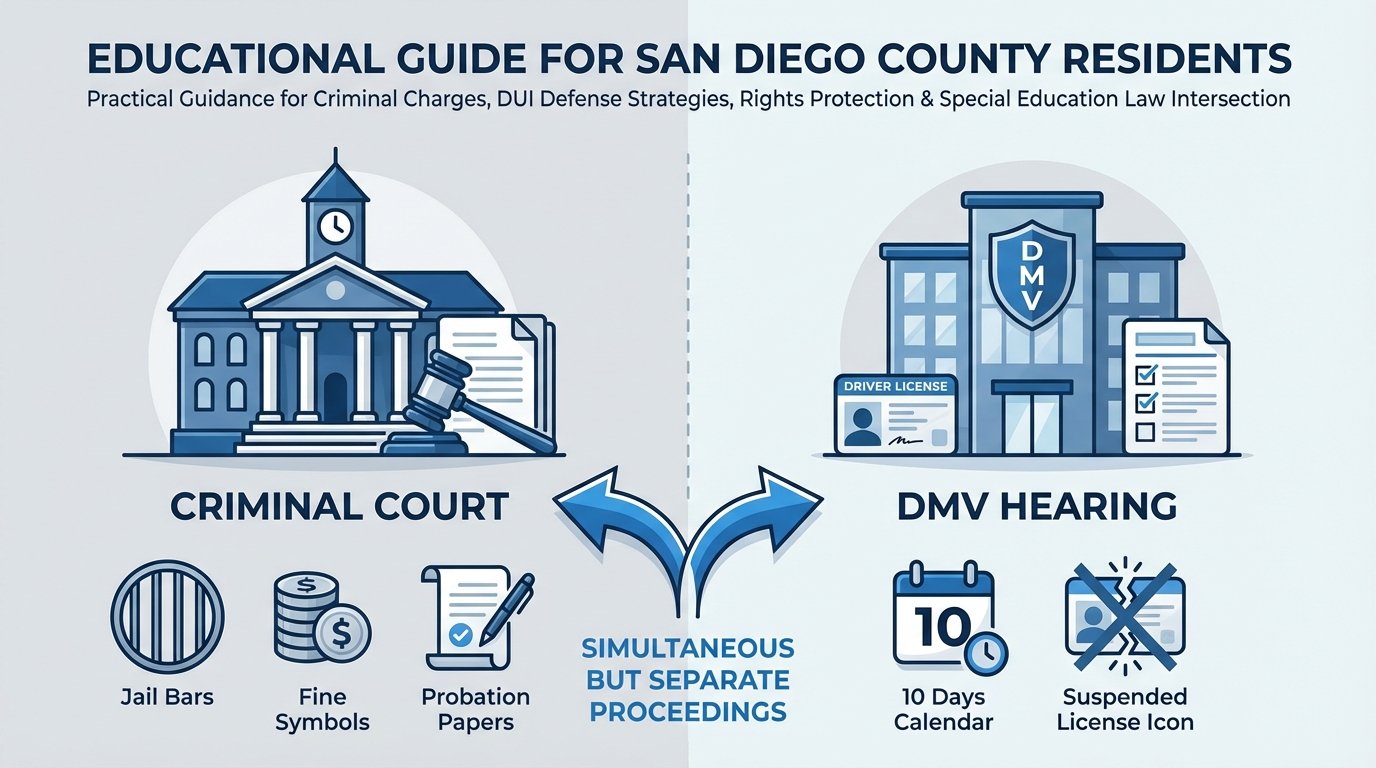
When you’re arrested for DUI in San Diego, two distinct proceedings begin immediately. The criminal case, handled through San Diego County Superior Court, addresses potential penalties including fines, jail time, and probation. Separately, the Department of Motor Vehicles initiates an administrative action targeting your driving privileges specifically. These proceedings operate independently, with different rules, timelines, and potential outcomes.
Many people mistakenly believe that if they fight the criminal charges, their license will automatically be protected. This isn’t true. You can win your criminal case but still lose your license through the DMV process if you don’t take proper action. Conversely, you might lose the criminal case but successfully preserve your driving privileges through effective DMV representation. Understanding this separation is the first step toward protecting yourself.
What Happens Immediately After Your Arrest
When law enforcement arrests you for DUI in San Diego County, the officer typically confiscates your physical driver’s license on the spot. In exchange, you receive a pink temporary license—officially called an “Order of Suspension/Revocation.” This document serves dual purposes: it’s your temporary license for the next 30 days, and it’s also your official notice of the DMV’s intent to suspend your driving privileges.
This pink slip contains critical information, including the date your suspension will begin (30 days from your arrest date) and notification of your right to request a DMV hearing. The officer should provide information about the hearing process, but in the stress and confusion of an arrest, these details often don’t register. By the time many people fully process what’s happened, valuable time has already slipped away.
The Critical 10-Day Window for DMV Action
You have exactly 10 calendar days from your arrest date to request an administrative hearing with the DMV. This deadline is absolute and unforgiving—miss it, and your license will be automatically suspended on the 30th day after your arrest. There are no extensions, and “I didn’t know” isn’t an acceptable excuse in the eyes of the DMV.
When you or your dui attorney san diego requests a hearing within this 10-day window, two important things happen. First, the hearing request triggers a stay of the suspension, meaning your driving privileges continue while you wait for your hearing date. Second, it preserves your right to challenge the suspension through a formal administrative process. Without requesting this hearing, you have no opportunity to contest the DMV’s action—the suspension simply takes effect automatically.
This is where having a dmv hearing attorney becomes invaluable. An experienced attorney can immediately request the hearing, ensuring you don’t miss the deadline while you’re still processing everything that’s happening. They’ll also begin preparing your defense strategy for both the DMV hearing and the criminal proceedings simultaneously.
What If You Miss the 10-Day Deadline?
If you don’t request a hearing within 10 days, your california drivers license suspension begins on day 30 after your arrest. The length of this suspension depends on several factors, including whether this is your first DUI offense and whether you refused chemical testing. First-time offenders who submitted to testing typically face a four-month suspension, while those who refused testing face a one-year suspension.
After missing the deadline, your options become limited. You may be eligible for a restricted license after completing certain requirements, but you’ll lose the opportunity to challenge the suspension itself. This is why immediate action—ideally by contacting a san diego dui lawyer within days of your arrest—is so important.
The DMV Administrative Hearing Process
The dui administrative hearing is your opportunity to challenge the suspension before it takes effect. These hearings are conducted by DMV hearing officers, not judges, and they follow different rules than criminal court proceedings. The hearing can be conducted in person or by telephone, and having a dui defense attorney represent you significantly improves your chances of a favorable outcome.
At the hearing, the DMV must prove three elements to sustain the suspension:
- The officer had reasonable cause to believe you were driving under the influence
- You were lawfully arrested
- Your blood alcohol content was 0.08% or higher (or you refused testing)
An experienced attorney challenges the DMV’s evidence, cross-examines the arresting officer, presents alternative explanations for observations and test results, and identifies procedural violations that could invalidate the suspension. These hearings are highly technical, and the hearing officers are experienced in evaluating DUI cases—they’re not easily persuaded by emotional appeals or general denials.
Types of License Suspensions and Their Durations
The length of your dui license suspension depends on your specific circumstances. For a first-time DUI offense in California where you submitted to chemical testing, the administrative suspension lasts four months. However, if you refused to take a breath or blood test, the suspension extends to one year, even for a first offense.
Second and subsequent offenses carry progressively longer suspensions. A second DUI within 10 years results in a one-year suspension if you took the test, or a two-year revocation if you refused. Third offenses trigger a two-year suspension (or three-year revocation for refusals), and fourth offenses result in a four-year revocation.
These are administrative suspensions only. If you’re convicted in criminal court, additional suspensions or restrictions may apply on top of the DMV action. This layering effect can create complex situations where understanding the interaction between administrative and criminal penalties becomes crucial for planning your future.
Restricted License Options During Suspension
California law provides restricted license options for many DUI offenders, allowing limited driving privileges during the suspension period. For first-time offenders, you may be eligible for a restricted license that permits driving to and from work, DUI program classes, and for work-related purposes if your job requires driving.
To obtain a restricted license, you typically must:
- Complete at least 30 days of the suspension period (for first offenses)
- Enroll in a DUI education program
- File an SR-22 insurance certificate showing proof of financial responsibility
- Pay reinstatement fees to the DMV
- Install an ignition interlock device (IID) on your vehicle
California’s ignition interlock device requirement has expanded in recent years. San Diego County is one of the pilot counties where IID installation may allow you to bypass some suspension time entirely. Your dui lawyer near me can explain how these programs apply to your specific situation and whether you qualify for early restricted privileges.
How Criminal Court Outcomes Affect Your License
While the DMV suspension proceeds independently, the outcome of your criminal DUI case also impacts your driving privileges. A DUI conviction in criminal court triggers mandatory license actions separate from the administrative suspension. These can include additional suspension periods, mandatory IID installation, and completion of DUI education programs.
For a first-time DUI conviction, the court typically imposes a six-month suspension. If you’ve already served part of the administrative suspension, these periods may run concurrently, but not always. Navigating how these overlapping suspensions interact requires detailed knowledge of both DMV regulations and criminal sentencing laws.
This is another reason why having comprehensive legal representation matters. A skilled attorney doesn’t just handle one aspect of your case—they coordinate defense strategies across both proceedings to minimize the total impact on your driving privileges and your life.
Fighting Both Cases: Why Coordinated Defense Matters
The evidence and issues in your DMV hearing and criminal case overlap significantly, but the strategies may differ. At the DMV hearing, your attorney focuses solely on preventing the suspension by challenging the evidence of intoxication and the validity of the traffic stop and arrest. In criminal court, the focus expands to include constitutional protections, procedural safeguards, and negotiating alternatives to DUI convictions.
The DMV hearing often occurs before the criminal trial, which creates a strategic opportunity. Your attorney can use the DMV hearing to cross-examine the arresting officer under oath, locking in their testimony and identifying weaknesses in the prosecution’s case. This information becomes invaluable for defending the criminal charges later.
Working with an attorney who handles both proceedings ensures nothing falls through the cracks. When you choose a solo practitioner rather than a large firm, you get consistent, personal attention throughout both processes. You’re not passed between different attorneys or paralegals—one experienced professional manages every aspect of your defense, ensuring coordinated strategy and thorough preparation.
The Real-World Impact of License Suspension
For most San Diego residents, losing driving privileges means more than inconvenience—it threatens employment, family responsibilities, and basic independence. San Diego’s public transportation system, while improving, doesn’t adequately serve many neighborhoods and employment centers. A suspended license can mean lost jobs, inability to transport children to school or activities, and isolation from support networks.
These practical realities underscore why fighting for your license matters so much. Even if you’re facing criminal charges, preserving your ability to drive—whether through winning the DMV hearing or securing restricted privileges—can mean the difference between maintaining stability in your life and watching everything unravel.
Your Path Forward After a DUI Arrest
If you’ve been arrested for DUI in San Diego, time is not on your side. Every day that passes brings you closer to that 10-day deadline for requesting your DMV hearing. While you’re trying to process what happened and figure out your next steps, the clock keeps ticking.
The most important action you can take right now is consulting with an attorney who understands both the DMV administrative process and criminal DUI defense. This doesn’t mean you’re admitting guilt or giving up—it means you’re protecting your rights and keeping your options open.
As a solo practitioner focused on criminal defense in San Diego County, I provide the personalized attention your case demands. You’ll work directly with me from the initial consultation through the resolution of your case—no shuffling between associates or paralegals, no wondering who’s actually handling your defense. I understand the San Diego County court system, the local DMV hearing procedures, and the prosecutors you’re facing.
I also understand that facing criminal charges creates financial stress. That’s why I offer flexible financing options to make quality legal representation accessible when you need it most. Your ability to defend yourself shouldn’t depend on whether you can pay a large retainer upfront.
Don’t let the 10-day deadline pass while you’re trying to handle this alone. Contact my office today for a consultation where we’ll review your arrest details, explain your options for both the DMV hearing and criminal case, and develop a coordinated defense strategy designed to protect your driving privileges and your future. The decisions you make in these first few days will shape everything that follows—make sure you’re making them with experienced guidance and a clear understanding of what’s at stake.